You're locked into ATP-D2, this is Signal & Noise, and I'm Clark Devereaux. Last week I asked where the category line lives. This week the answer, or at least the trouble, is everywhere: in the sales call, in the fake text thread, and now in a Supreme Court petition asking whether a federally regulated market is a brokerage or a blackjack table. Same body, new costumes. Let's check the sky before somebody tries to sell you thunder.
The Weather Report

The tape looked friendly if you only read the headline. The S&P 500 added about 1% on the week, the Nasdaq tacked on roughly 1.5%, and the mood board says risk-on. But get underneath the hood and it's a mega-cap carry job: the Russell 2000 barely kept pace at around half a percent while the giants did the lifting. That's not broad prosperity. That's a few big engines towing a lot of glossy marketing copy behind them.
Rates matter here because rates are the lighting department for this whole industry. The 10-year is sitting around 4.75%, and Governor Waller's hold-steady talk knocked September hike odds from roughly 58% down into the high-40s on CME FedWatch. In a regime where passive large-cap exposure can look like brilliance, every AI-trading salesperson gets a free tailwind. Backtests look cleaner, demos look smarter, and one lucky chart starts dressing up like a system.
That's why this week's weather is not just scene-setting. It's the receipt. If a Nasdaq-heavy product is showing you before-and-after miracles in a market where mega-cap tech has been doing the heavy lifting, the first question is not how intelligent the model is. The first question is whether the tape is doing the work and the brochure is taking the bow.
This Week in AI Investment Technology
And that brings me downstairs to the showroom floor, where this category keeps changing jackets but never really changes its shirt.
STO Systems Won't Tell You What It Costs Until It's Already Got You On A Sales Call — That's Not an Accident
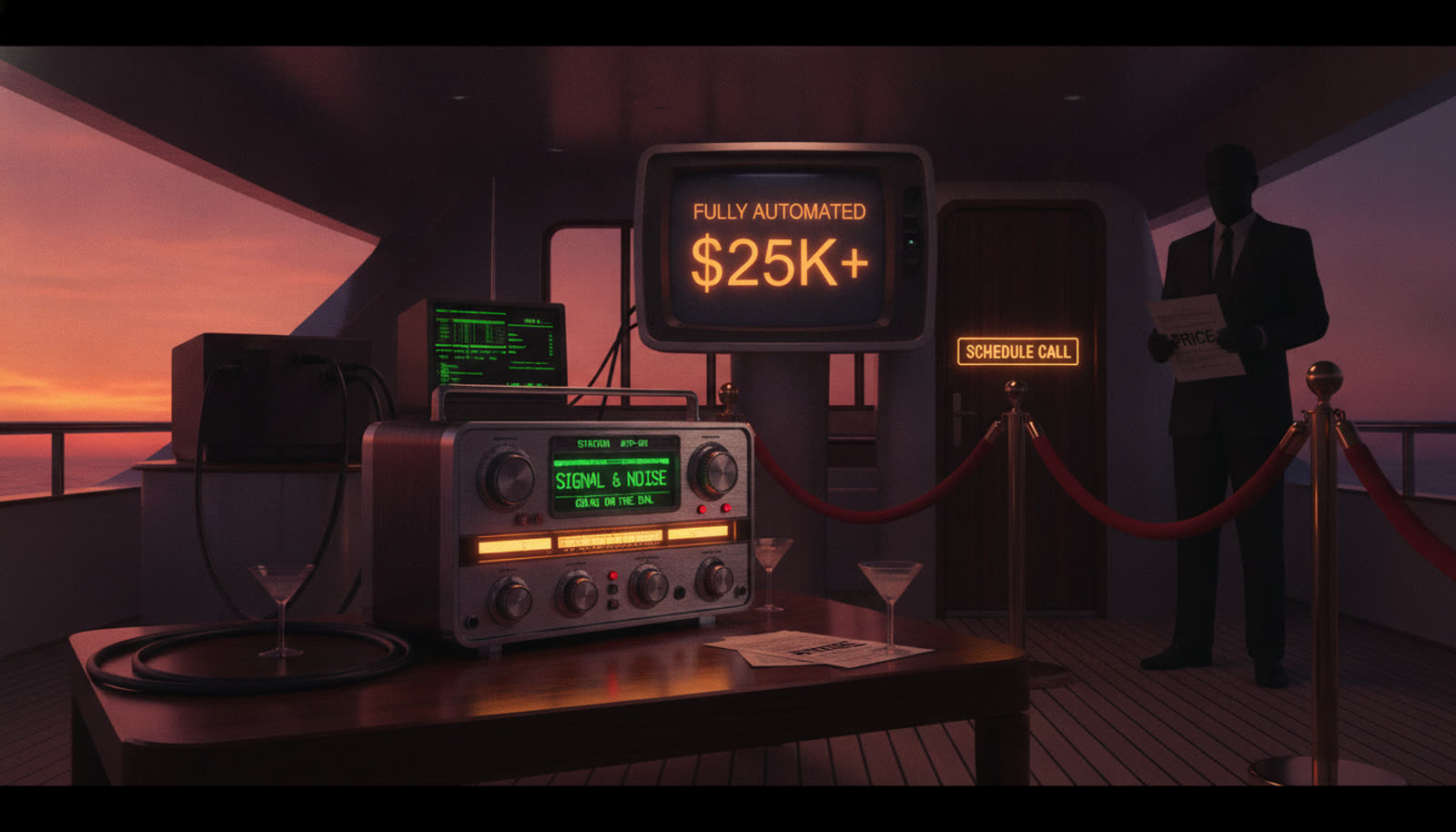
STO Systems is selling one of the most seductive lines in this whole business: fully automated NASDAQ futures trading, deployed inside your own U.S.-regulated brokerage account, while the company says it never holds or touches client funds. On the surface, that's elegant. It borrows the comfort of your own brokerage custody while keeping the magic box somewhere just out of reach. Then you look for the part that matters — price — and the floor drops out. Across the publicly indexed pages on stosystems.co and sto.systems, the only numeric threshold surfaced is that it's for investors with $25K+. No subscription figure. No performance fee percentage. No minimum contract term. The only path forward is to answer questions and schedule a call.
That is not an accident. That is a sales instrument. Prediction 4 says very few genuinely autonomous, no-human-in-the-loop platforms emerge — and the ones that do are expensive. This week's reading: STO Systems publicly markets full automation and bring-your-own-broker custody, but hides every meaningful commercial term behind a call gate, exactly the pattern you'd expect when the price is meant to be discovered on you, not by you. The company's copy also says the system is built and overseen by an ex-prop-firm quant and not left to run unsupervised. Fine. Name the person. Surface the credential. Show the registration anchor if one exists. In the indexed material provided, none of that is there.
So what is it really? A black-box technology vendor with a nice custody story, a credibility halo, and opaque economics. I am not calling it illegal. I am not calling it a scam. I am saying the questionnaire-plus-call structure is a price-discrimination machine by design. It figures out your assets, your urgency, your sophistication, and then somebody on the other end decides what the box costs. When the sax hits in this category, this is usually the shot where you realize the speedboat was towing the bill of sale the whole time.
See STO Systems' public landing page →📡 The Ledger · Ledger 4
On the record: Prediction 4: truly autonomous trading platforms are rare, and the real ones hide behind expensive, opaque pricing.
This week’s reading: STO Systems markets fully automated NASDAQ futures in your own brokerage account, but its indexed public pages disclose no subscription price, fee split, or contract term beyond an investors with $25K+ threshold.
VantagePoint AI's Fake iMessage Ad Is the Newest Costume on the Oldest Con — And 'The Proof' Newsletter Is Survivorship Bias With a Bow On It
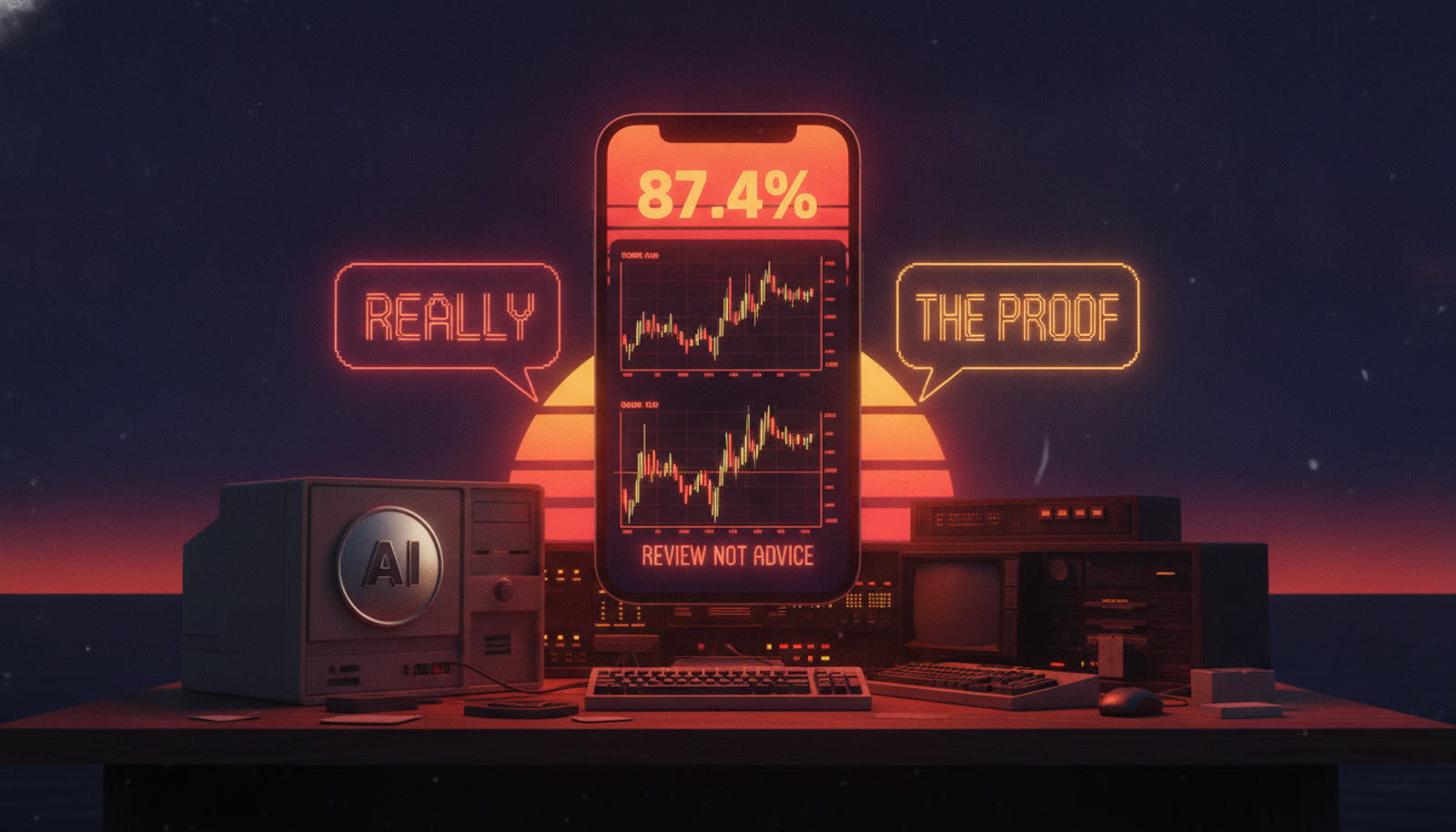
I want to give VantagePoint AI its due on one point: the fabricated iMessage-thread creative is slick. It is good advertising craft. It takes a marketing claim and disguises it as a private conversation between a skeptic and a friend. You, the viewer, get cast as the smart one in the room, and then the chart arrives to answer your skepticism. That's a clever costume. But it is still a costume. Nobody texted you. The conversation did not happen. The chart is still an ad.
Underneath that costume is an older body. VantagePoint AI is a long-running Windows-based forecasting and charting package. It does not execute trades or custody funds. It generates directional signals for user-discretionary trading. Its marketing claims accuracy up to 87.4%, described as validated by third-party testing, while the methodology is not publicly available or peer-reviewed in the material cited here. Pricing is not prominently published on the main sales surface; outside reviews describe packages starting around $2,900, climbing through higher tiers up to roughly $5,900 to $9,900, with promotional annual plans around $1,495 and a direct-sales motion wrapped around the whole thing.
Then there is The Proof newsletter, which is the emotional center of the pitch. One stock per week. Analyst disagreement. AI indicator read. Documented outcome. Big confident language about nothing being cherry-picked and wins and misses being shown the same way. And then, sitting there doing the actual legal work, the disclaimer: this is a review, not advice; we are not telling you what to buy or where a stock is going. Prediction 1 says fake-AI trading products appear faster than anyone can shut them down. This week's reading: not every costume is a newborn website. Sometimes the fake-AI move is an old software product wearing a fresh AI cape and a staged text-message skin, while its most concrete public proof remains curated and externally unverifiable.
I am not calling VantagePoint a scam. It is an established software seller with a long operating history. I am saying the gap between what the creative implies and what the fine print confirms is wide enough to taxi a floatplane through. And in a market where a Nasdaq-heavy chart can make almost anybody look prophetic, that gap matters.
See VantagePoint AI's main platform site →📡 The Ledger · Ledger 1
On the record: Prediction 1: fake-AI trading products keep flooding the market faster than anyone can clear them away.
This week’s reading: VantagePoint's newest costume is a fabricated iMessage-style ad and a one-stock-per-week proof narrative, while the underlying product remains discretionary signal software with self-limited transparency and sales-led pricing.
New Jersey Just Asked SCOTUS Whether Kalshi Is a Trading Platform or a Casino — And That Question Is Going to Define the Whole Category

Last week I told you Kalshi had moved from sideshow to real jurisdiction fight. This week the fight climbed another deck. On September 2, New Jersey's attorney general asked the U.S. Supreme Court to review the question at the center of this mess: when a market offers event contracts under federal regulatory structure, can a state still treat those contracts as gambling and shut them down? Reuters, WUSF, ESPN, and U.S. News all confirmed the filing and the stakes. The petition follows the Ninth Circuit's August 28 ruling that Nevada can enforce its gambling laws against Kalshi's sports-event contracts.
Prediction 9 says prediction markets gain real popularity but get lumped in with sportsbooks and fought as gambling. This week's reading: New Jersey has now asked SCOTUS to resolve whether state gambling regulators can override a CFTC-regulated event-contract venue, which is exactly the kind of existential casino-versus-market fight the prediction called for. And yes, it also feeds Prediction 7, because this is what rulemaking looks like when the rulebook arrives through lawsuits first.
Why do I care in an AI-investing column? Because this is the dry run. The legal question here is really classification under pressure. When something walks like a bet, who gets to say what it is? The twin question waiting its turn in this industry is: when an AI signal walks like investment advice, who gets to say what that is? States do not start these fights because they enjoy philosophy. They start them because money, authority, and jurisdiction are all on the table at once.
Read Reuters on New Jersey's Supreme Court petition →📡 The Ledger · Ledger 9
On the record: Prediction 9: prediction markets will grow, then spend that growth defending themselves from being called casinos.
This week’s reading: New Jersey's September 2 cert petition asks the Supreme Court to decide whether states can apply gambling law against Kalshi's federally regulated event contracts.
Mega-Cap AI Tailwinds Are Doing the Work That 'AI Trading Platforms' Are Taking Credit For — Know The Difference Before You Pay $3,000 For a Newsletter

Here's the honest contrast case, and it's not even a platform teardown so much as a weather correction. This week's tape was generous to the exact kind of charts AI-trading marketers love to parade around. The S&P 500 rose about 1%, the Nasdaq about 1.5%, the Russell lagged, and the big technology names did the heavy lifting while rate-hike odds eased. In that environment, a before-and-after chart of a mega-cap or Nasdaq-heavy name is not proof of special intelligence. It's often just proof that gravity was suspended for the right basket of stocks.
Prediction 2 says the big trusted firms stay quiet, or quietly position themselves as the grown-up. This week's reading: while expensive AI-marketing stacks turn favorable market beta into implied genius, the regulated incumbents keep doing the boring thing — broad exposure, full disclosure, low fees, no AI-autopilot sermon required. That silence is not a lack of imagination. Right now it's the cleanest contrast in the room.
This does not prove every active system is useless. It proves the evaluation problem gets brutally hard during a mega-cap bull phase. If a seller shows you a triumphant chart from the past 18 months and asks for software money, your first job is to separate alpha from a tailwind any cheap index product would have given you. That distinction is the whole damn case.
Read this week's market context →📡 The Ledger · Ledger 2
On the record: Prediction 2: the big trusted firms stay quiet and let boring, regulated investing speak for itself.
This week’s reading: With the S&P up about 1% and the Nasdaq up about 1.5% on mega-cap leadership, passive and regulated exposure explains a lot of the gains that AI-trading marketers would like to frame as product brilliance.
Clark’s Corner
Last week I was asking where the category line lives — how far a real business can go before the law says it's wearing a different uniform. This week that question got sharper. Maybe the better version is not where the line lives, but what would make the line auditable.
STO won't show price until it sizes you up. VantagePoint shows one polished outcome at a time and tells you not to call it advice. Kalshi has states and federal regulators arguing over which rulebook even applies. Three different products, one shared disease: the buyer cannot independently reconstruct the truth from the seller's presentation.
So here's the question I'm carrying off the yacht tonight: what is the minimum disclosure set that would let a normal person verify an AI-assisted trading product without trusting its marketing voice at all? Not vibes. Not testimonials. Not one hero chart. I mean a check-the-math packet: full signal distribution, fee schedule in daylight, execution path, custody chain, who is registered where, and what a miss looks like in the same font size as a win. If somebody built that standard, would the market reward it — or would the louder costume still win?
I don't have that answer yet. But I know this much: every platform we've looked at keeps telling us, in its own fine print, why it doesn't want to be compared that way.