You’re locked into ATP-D2, this is Signal & Noise, and I’m Clark Devereaux. This week’s hook is simple: the fine print is the honest part of the product. The ad gets the saxophone, the disclaimer gets the truth, and when those two start telling different stories, I put my beer down. Let’s get to the weather.
The Weather Report

The tape finally caught its breath. CNBC had the Nasdaq snapping a six-day losing streak on July 29, and the S&P 500 has managed modest gains since. But the headline number is not the story I care about. Underneath it, the so-called Magnificent Seven that hauled this market uphill all spring are getting outpaced by the other 493 names in the index, which were up roughly 14% through mid-July. That kind of rotation matters, because when the sexy AI-stock trade stops doing all the work, every retail pitchman with an 'AI investing' funnel suddenly has to sell harder.
The Fed is still standing there with its arms crossed. Merrill’s August 19 Washington Update says no new cuts in August, which means cash still pays something, risk still has a price, and yield-hungry retail money stays restless. Restless money is catnip for this whole industry. If you can’t get the easy multiple expansion story from seven giant tech names anymore, the next salesman in the feed is going to offer you a shortcut — an analyst army, a funded account, a one-hour payout, some machine that never sleeps. Same old movie, just with a shinier speedboat.
And that’s the weather for our beat: choppier leadership, steady rates, nervous retail appetite. When the broad market starts carrying the load instead of the AI aristocracy, the gap between real investing and theatrical marketing gets wider, not narrower. That’s when the saxophone kicks in, and that’s when I go straight to the footnotes.
This Week in AI Investment Technology
Three specimens this week, plus one regulatory slow-burn, and they all share the same structural DNA: a marketing claim that sounds like technology, a fine print confession that reveals a much older business, and a price tag designed to keep you from lingering in the space between them.
A thousand analysts in the ad, a newsletter in the disclosures
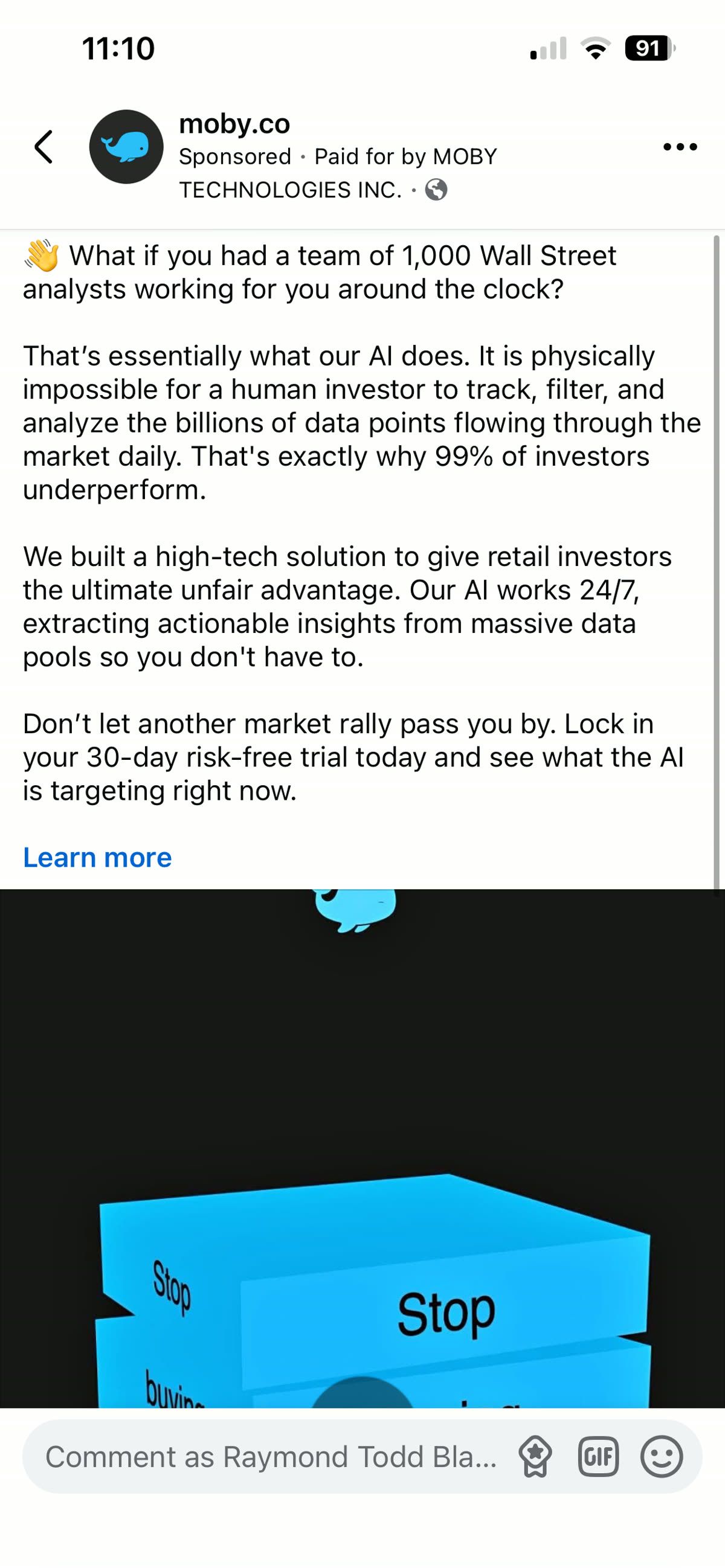
Moby is selling institutional atmosphere. On its homepage and in paid social, you get the framing of a research machine — even the line about 'a team of 1,000 Wall Street analysts working around the clock' and a 30-day risk-free trial. Then you hit Moby’s own advertiser disclosures and the whole thing turns back into what it actually is: 'this is not investment advice' and 'nothing on Moby should be construed as personalized investment advice — all content is for informational purposes only.' A dedicated email distributed on the platform goes further and says flat-out: 'Moby is not a registered investment advisor or broker-dealer.' That’s the truth-telling part of the act, and to their credit, it’s written down in black and white.
So what is it really? A stock-pick subscription. Third-party reviews captured in this brief describe the product as three stock picks per week delivered by app and email, with Moby Premium around $29.95 a month or $199.95 a year, often discounted through partner funnels. The Wall Street Survivor co-branded landing page pushing '73% off Moby Premium' via email capture is the tell. This is tip-sheet architecture wearing AI-adjacent wardrobe. Legal? Yes. Common? Extremely. The problem is not that the product exists. The problem is that the ad is doing a hell of a lot of work before the disclosure walks in and takes the makeup off.
And then there’s the math. ZoomInfo lists Moby at roughly five to nine employees and about five to ten million in revenue. That does not prove the '1,000 analysts' line is false in some legal sense — it may be metaphor, sourcing, contractor language, who knows — but it sure as hell makes the literal reading wobble like a cigarette boat taking a hard turn. Same thing with the homepage claim that 'over 30 million people' rely on Moby’s research: it’s there, but it was not independently verified in the material for this episode. So I’m not calling Moby a scam. I am saying the gap between the headline and the footnote is the product.
Prediction 5 on the Ledger says this: most 'AI trading' apps are stock tips, not algorithms — the real product is a recommendation feed, and the user still executes the trade. This week’s reading: Moby’s own disclosures say it is not giving personalized advice and is not a registered adviser or broker-dealer, while the captured product structure is a paid stream of stock picks sent to the user. Receipt: Moby’s advertiser disclosures, Moby’s dedicated email, and the subscription descriptions documented by Wall Street Zen and Wall Street Survivor.
Read Moby’s own disclosures →📡 The Ledger · Ledger Prediction 5
On the record: Most 'AI trading' apps are stock tips, not algorithms — the real product is a recommendation feed, and the user still executes the trade.
This week’s reading: Moby’s own disclosures strip the costume off: not personalized advice, not a registered adviser or broker-dealer, and in practice a paid stream of stock picks delivered by app and email.
The day-four payout fantasy runs through a fee pool and a tougher risk regime

Take Profit Trader knows how to write a headline. On August 17 it announced permanent 3-day evaluations, paired with a one-week 50% discount and zero activation fee promo. The emotional promise is obvious: pass fast, get funded fast, get paid fast. The blog also keeps the 50% consistency rule in place, so no single day can account for more than half your cumulative evaluation profits. Fine. Rules are rules. But the seduction is in the compression. Three days sounds like velocity. Day 4 sounds like arrival.
Now here comes the saxophone. Independent guides in this brief spell out what the headline leaves in soft focus. The evaluation uses end-of-day trailing drawdown. The PRO account you trade after passing switches to intraday trailing drawdown, which TradersPost describes as stricter than it looks. Before you can withdraw from PRO, those same guides say you must first generate profits equal to the full maximum drawdown amount — a buffer requirement. So the practical sequence is not 'pass in three, paid on four.' It is: pass in three under one rule set, move into a more demanding simulated funded environment, build a cushion equal to your total drawdown limit, then request payout, then wait through processing. That is a very different movie from the trailer.
The most important disclosure is on Take Profit Trader’s own main site: payouts from PRO accounts are funded from collected evaluation fees, technology fees, and a share of PRO+ profits — not from live market trading profits. That matters because it tells you what business you are actually standing in. The challenge fee is not just admission to a dream. It is the engine. The trader who gets rewarded is being paid out of an economic structure built largely from the fees of traders who did not. Again: that is not a hidden accusation. That is the company’s disclosed architecture, plus the mechanics documented in the named third-party guides here. Trustpilot shows a strong 4.4 to 4.5 range with thousands of reviews, many from invited customers, so I’m not here to pretend there aren’t satisfied users. I’m here to say the slogan and the structure are not the same thing.
Prediction 3 on the Ledger says this: prop-bet firms rise and drag algo trading’s reputation down with them — the funded-account challenge business booms, blurs into algo trading, and taints the category by association. This week’s reading: Take Profit Trader is a transparent, functioning prop-firm machine whose own site says payouts are funded from fees, while its marketing compresses a complicated simulated-account process into a day-four fantasy. Receipt: the company’s 3-day eval announcement, its main-site payout disclosure, and the TradersPost and Velotrade explanations of the drawdown switch and profit-buffer requirement.
Read the 3-day eval announcement →📡 The Ledger · Ledger Prediction 3
On the record: Prop-bet firms rise and drag algo trading’s reputation down with them — the funded-account challenge business booms, blurs into algo trading, and taints the category by association.
This week’s reading: Take Profit Trader’s own disclosures show a fee-funded simulated-account model, while the marketing sells speed and simplicity that the intraday drawdown switch and buffer rules materially complicate.
The disclaimer made the poster, and that tells you where regulation is heading

Tradeify gave me my favorite shot of the week because it skipped the usual dance step. The ad itself, as captured in this brief from the week of August 23, already says the quiet part out loud: simulated trading accounts, no real capital, results are hypothetical. Not buried in the footer. Not tucked into terms nobody reads. In the ad. Right there beside the offer: about $59 for a 25K Growth Plan simulated futures account with promo code NEW, plus one-hour payouts and no activation fee. That is weirdly more honest than a lot of this industry, and it is also a giant neon sign that the lawyers are now in the room.
Because that shift does not happen by accident. The backdrop in this brief is an approximately $850 million retail prop-trading sector under pressure from enforcement and guidance around hypothetical performance and the presentation of simulated trading as if it were live. So Tradeify’s creative appears to be adapting in real time: let the front-end promise do the seduction, but move the legal ballast into the same frame so nobody can say you hid the ball. I respect that as a strategy. I also think it tells you the industry can smell the regulators from the marina.
I’m staying disciplined here because the research on Tradeify was truncated. We did not capture the full fee schedule, complete drawdown mechanics, payout denial patterns, or an independent review base robust enough to say more than the brief supports. So I’m not going to freestyle facts I don’t have. What I can say, cleanly, is that Tradeify is advertising simulated accounts with no real capital, hypothetical results, a roughly $59 entry point for the 25K promo plan, one-hour payouts, and no activation fee. That combination — full simulation disclaimer plus emotional payout language in the same ad — is the story.
Prediction 3 on the Ledger says this: prop-bet firms rise and drag algo trading’s reputation down with them — the funded-account challenge business booms, blurs into algo trading, and taints the category by association. This week’s reading: Tradeify is openly selling a simulated funded-account experience and now placing the simulation disclaimer inside the ad itself, which suggests a maturing legal-defense posture in a category already under scrutiny. Receipt: Tradeify’s site as captured in the brief, and the broader regulatory context summarized in this week’s research.
Visit Tradeify →📡 The Ledger · Ledger Prediction 3
On the record: Prop-bet firms rise and drag algo trading’s reputation down with them — the funded-account challenge business booms, blurs into algo trading, and taints the category by association.
This week’s reading: Tradeify is selling simulated funded trading with the simulation disclaimer moved onto the face of the ad itself — a sign the category is adapting to mounting scrutiny while keeping the fee-driven challenge model intact.
Two circuits, no ruling, no new CFTC move — the silence is the signal

Kalshi is this week’s reminder that sometimes the loudest thing in markets is nothing happening on the record. In the Sixth Circuit case, KalshiEX LLC v. Matthew Schuler, the most recent docket activity captured here is a March 31, 2026 response in opposition to a motion. No panel ruling, no summary order, no bench flare since oral argument. In the D.C. Circuit matter against the CFTC, no decision, no fresh order, no visible bench signal in the past 30 days. And over the same window, the CFTC has not opened a new rulemaking notice or comment period that would move the framework along.
That stall is not meaningless drift. It’s the shape of a hard classification fight. Are prediction-market contracts on elections and events regulated futures under federal commodities law, or are they gambling products that states can swat down anyway? That distinction is not academic. It determines how these platforms are marketed, who gets to regulate them, and whether the retail user is stepping onto an exchange or into a casino argument wearing a blazer. While the courts take their time, Kalshi gets to keep growing into the ambiguity.
Prediction 9 on the Ledger says this: prediction markets like Kalshi gain real popularity but get lumped in with sportsbooks and fought as gambling — they grow fast and spend that growth defending themselves from being called a casino. This week’s reading: both active federal court tracks remain unresolved, the CFTC is quiet, and the category is still operating at scale inside a legal frame that has not fully decided what it is. Receipt: the Sixth Circuit docket on CourtListener and the current absence of new movement noted in this brief.
Track the Sixth Circuit docket →📡 The Ledger · Ledger Prediction 9
On the record: Prediction markets like Kalshi gain real popularity but get lumped in with sportsbooks and fought as gambling — they grow fast and spend that growth defending themselves from being called a casino.
This week’s reading: Both federal court paths are still pending and the CFTC is silent, which means Kalshi keeps expanding while the legal system still has not settled whether this category is exchange, gambling, or some unstable hybrid.
Clark’s Corner

Here’s the question nobody building these things seems willing to ask out loud: what would the platform look like if the disclaimer came first and the pitch came second? Not as compliance garnish. Not in six-point type under the button. I mean the honest version, right up front. 'We are not your adviser.' 'This is simulated capital.' 'Your payout comes from fee pools.' 'You still carry the execution risk.' If that version kills conversion, then the disclosure wasn’t just disclosure — it was the load-bearing truth the business needed hidden to function.
And maybe that’s the whole industry in miniature. The loud part creates the emotion. The quiet part allocates the risk. Everybody I covered tonight told the truth somewhere. Moby told you it isn’t your adviser. Take Profit Trader told you where payouts come from. Tradeify told you the capital is fake. The honest sentence exists. It just never gets the close-up unless regulation is close enough to smell.
So that’s my open thread tonight: is there a version of this business that can survive with the footnote as the headline? I don’t know yet. But when the saxophone kicks in, put your beer down, because that’s the question I’ll be chasing next week.