You're locked into ATP-D2, this is Signal & Noise, and I'm Clark Devereaux — broadcasting for the first time from the new tower. That's right: we moved. The station has its own frequency now, its own address, and if you spin the dial all the way past 107.9 you come back around and find us sitting pretty at 89.9. Every past transmission made the trip, and so did something new: the Intercepts — every product this desk has ever torn down, in one directory, each one wearing one of exactly two stamps. SIGNAL: it's legit or close to it, worth watching. NOISE: keep your wallet in your pocket and keep walking. There is no third stamp. The fence is not a place to sit.
And brother, did the news gods bless the housewarming. A federal appeals court just broke a silence I've been tracking for three straight episodes. But first — a special Saturday broadcast still opens like every broadcast. The weather.
The Weather Report
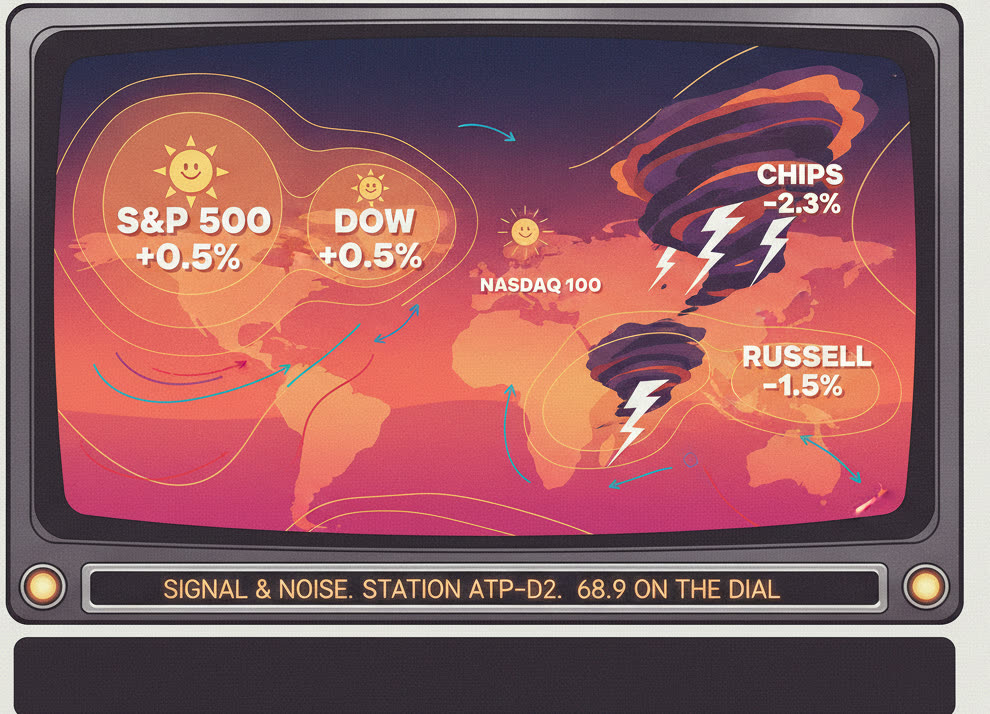
The last full trading week of August ended green on the surface and split right down the middle underneath. The S&P 500 put on about half a percent, the Dow matched it, and the Nasdaq-100 crept up a few tenths — while the semiconductor index dropped 2.3% and the small-cap Russell gave back 1.5%. That's not a rally; that's a tug-of-war with the rope fraying in the middle.
The AI theme itself passed its big exam: Nvidia reported into enormous expectations and guided revenue above them, and strong outlooks from Salesforce and CrowdStrike pushed back on the software-gets-eaten story. But Marvell dropped seven percent over the timing of when its AI chip deal with Google actually turns into money — and that word, timing, is the whole nervous system of this market right now. Everyone believes the AI money is real. Everyone is getting twitchy about when.
Then Friday, Fed Chair Warsh stood up at Jackson Hole and reminded everybody who's holding the checkbook. The hawkish speech spiked the odds of a September rate hike to roughly 60% on the CME's FedWatch tool — up from about 35% before he opened his mouth. The ten-year is parked at 4.66%. Money stays expensive, and it might be about to get more expensive.
Why does a fine-print show care? Because this exact mix — AI leaders printing money, everything else bleeding, and a Fed threatening to raise — is the habitat where the shortcut industry feeds. When the only trades working are seven stocks you already can't afford, somebody in your feed will sell you a machine that catches up. This week I've got three of them on the slab, and for once, one of them earns the good stamp.
This Week in AI Investment Technology
Specimen: the newsroom · Stocks.news
The 'signal, not noise' news app is copyrighted to a stock-promotion agency — and that's the whole review
Stocks.news came in off a Facebook ad promising it "monitors NYSE and NASDAQ 24/7" and hands you the top 50 gainers and losers "in about ten seconds." The app itself is a slick package: real-time alerts, Form 4 insider-filing trackers, congressional trade disclosures, a live SEC feed, paper trading, and curated daily market news filtered — I swear I am not making this up — "for signal, not noise." Flattered. Truly. Now let's read the copyright line.
"© 2026 IR Agency, LLC."
IR stands for investor relations. An entity by that exact name signs consulting agreements — you can read one filed with the SEC — to provide "marketing and advertising services" that "communicate information about the Company to the financial community." A promotion shop at the same name pitches issuers with lines like putting "the spotlight on your best side" so that "ambitious, bold investors" will research their stock. That is a legal, real industry: companies pay it to make their tickers look interesting.
So here is the only question that matters about a news product, the one every real newsroom answers on page one: who pays for the news? Advertisers pay CNBC. Subscribers pay Bloomberg. Stocks.news is a "financial information platform" — its own disclaimer's words, not advice, informational purposes only — copyrighted to a firm in the business of being paid to get stocks in front of you. I'm not going to claim any specific alert was a paid placement; I don't have that receipt. But the SEC has been dragging undisclosed stock promotion dressed as independent analysis since at least 2017, and an app store reviewer's love letter here reads, quote, "Sometimes it's a miss... But when they hit they hit freakishly hard." Friend, a wire service isn't supposed to hit. A tout sheet is.
Read the SEC's warning on paid stock promotion dressed as news →
On the record, July 22, 2026: "Algo-trading scams keep flooding the market for at least the next 12 months — new fake-AI products appear faster than anyone can shut them down."
This week's reading: the tide is learning new costumes. The funnel of week one wore a robot mascot; this week's specimen wears a newsroom. The body count continues, and the wardrobe budget is going up.
Specimen: the workbench · DayTradingStrategies.net
One guy, 150 ThinkorSwim codes, a refund policy, and zero AI cosplay — the queue finally coughed up a SIGNAL
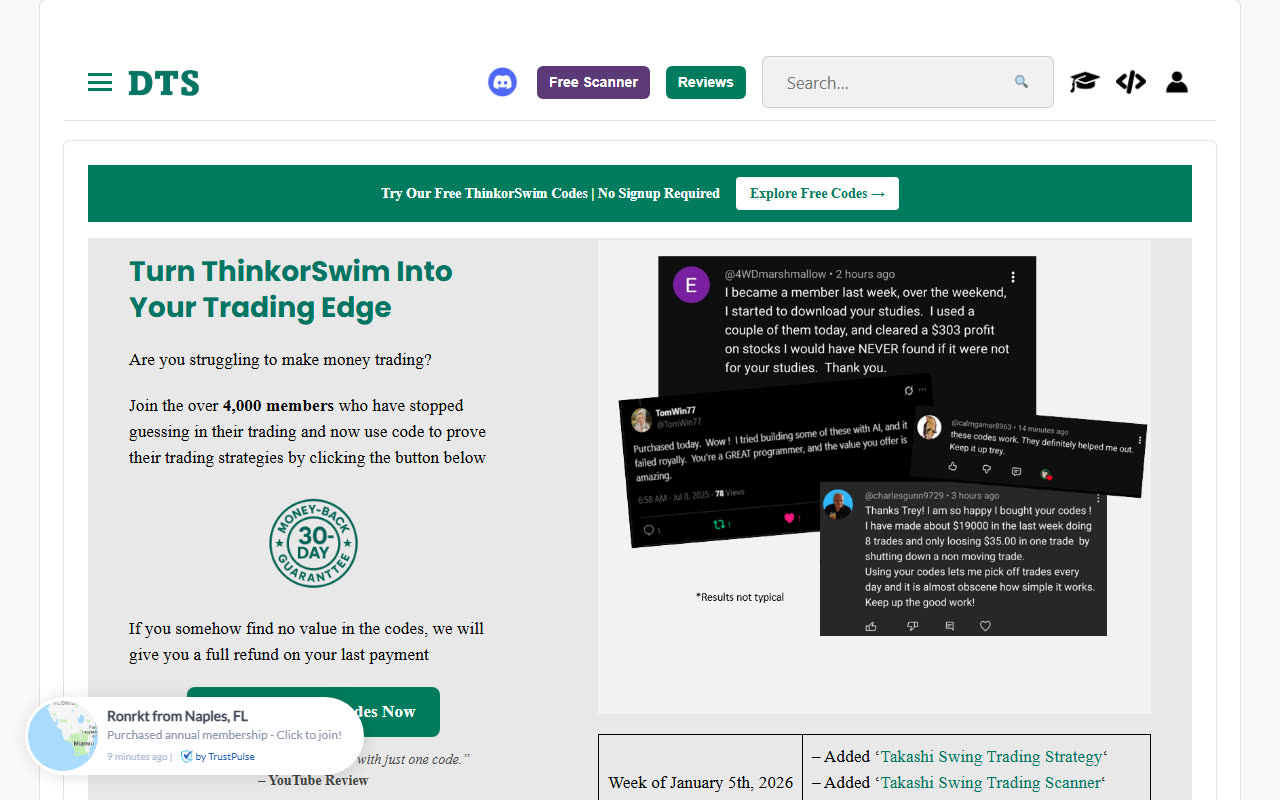
DayTradingStrategies.net sat in this queue since July under the archetype "research tool dressed as AI," and I walked in with the stamp already inked. Then I read the site, and the damnedest thing happened: nobody tried to lie to me.
DTS sells custom indicator and strategy code for ThinkorSwim — 150-plus scripts, a subscription with weekly updates, free codes you can grab without even signing up, and a how-to-code course. The founder, Trey, is a sole proprietor who puts his own name and family on the page: "when you sign up to this website, your money doesn't go to some big company or corporate office." The pitch to "join over 4,000 members who have stopped guessing" and use code to prove their strategies is — and I can't believe I get to say this on air — the methodologically correct sentence. Test the damn thing before you trust it. If you find no value, the site says, full refund on your last payment.
Now the warts, because a SIGNAL stamp is not a love letter. The proof on offer is testimonial-grade — a YouTube quote about making back the membership "with just one code" is marketing, not an audit. The subscription treadmill framing ("your passport to ongoing success") deserves a raised eyebrow. And no indicator, custom or otherwise, gives you foresight; a scanner tells you where the fish were biting, not where they'll bite. But notice what's absent: no AI branding, no autonomy theater, no funded-account fantasy, no secret pricing behind a sales call. It's a workbench, sold as a workbench, by a guy with a name. After six weeks in this sewer, that reads like poetry.
See the workbench for yourself →
On the record, July 22, 2026: "Most 'AI trading' apps are stock tips, not algorithms — the automation just executes what the user already approved."
This week's reading: confirmed from the honest end. DTS doesn't even sell the tips — it sells the toolbox and tells you to test your own ideas. When the product stops pretending to think for you, it stops needing to lie about what it is.
Specimen: the listicle · Elevate Wealth's "10 Best AI Stocks to Watch in 2026"
The picks are mainstream, the disclaimer is clean, and the product is you

Third specimen is the softest species in the file: the SEO listicle. Elevate Wealth — a Dubai advisory outfit — publishes "10 Best AI Stocks To Watch In 2026," and the picks are exactly what you'd guess: Nvidia, TSMC, AMD, Microsoft, Meta, Palantir, the whole varsity squad, garnished with genuinely reasonable observations about following Big Tech's $405-billion capex down the supply chain.
I went in loaded. The disclaimer says "Elevate Financial Services LLC is regulated by the Capital Market Authority (CMA) of the UAE," and I was ready to nail them for citing a regulator that doesn't exist — the UAE's securities cop has been called the SCA for as long as I've been reading fine print. Except the frisk came back clean: the UAE renamed its regulator the Capital Market Authority effective January 1, 2026. The fine print isn't just present, it's current. Tip of the cap.
So why is a clean listicle on this show? Because of what it's for. Scroll to the bottom of those ten mainstream picks and there's the real product: "Book Your Free Consultation." The article exists to rank on Google when you search "best AI stocks," so a percentage of readers convert into advisory clients. Nothing illegal, nothing even rude. But understand what you're reading: not research produced to inform you — chum produced to catch you. The picks are the bait, the consultation is the hook, and every content mill on the internet is running the same trotline with worse disclaimers. As investment intelligence it adds precisely nothing you couldn't get from a index fund's top-ten holdings list. That, by this station's definition, is noise.
On the record, July 22, 2026: "Most 'AI trading' apps are stock tips, not algorithms — the real product is a recommendation feed."
This week's reading: the listicle is the tip feed's SEO cousin — same tips, zero app, and the recommendation feed doesn't even want your subscription. It wants your phone number.
The rulebook · Kalshi / Ninth Circuit
The silence broke: Nevada wins, the circuits split, and 'is it gambling?' is headed for the big table
For two straight episodes I told you the most interesting fact in the Kalshi file was that nobody with authority was saying anything — the Sixth Circuit sat silent after argument, the CFTC sat parked, and I called the silence itself the signal. On Thursday, August 28, the silence broke. From the other coast.
In KalshiEX, LLC v. Assad, a unanimous Ninth Circuit panel ruled that Nevada can keep enforcing its gambling laws against Kalshi's sports-event contracts. The court affirmed dissolving Kalshi's injunction against the Nevada Gaming Control Board, reasoned that these sports contracts likely fall outside the federal swap definition, and pointed at the CFTC's own regulation — the one that currently prohibits listing gaming contracts — as blocking exactly what Kalshi lists. Election contracts got remanded for another look. Companion rulings swept in Crypto.com's derivatives arm and Robinhood's. Nevada's lawyer called it "a resounding victory for Nevada and for the other states," and she's not wrong.
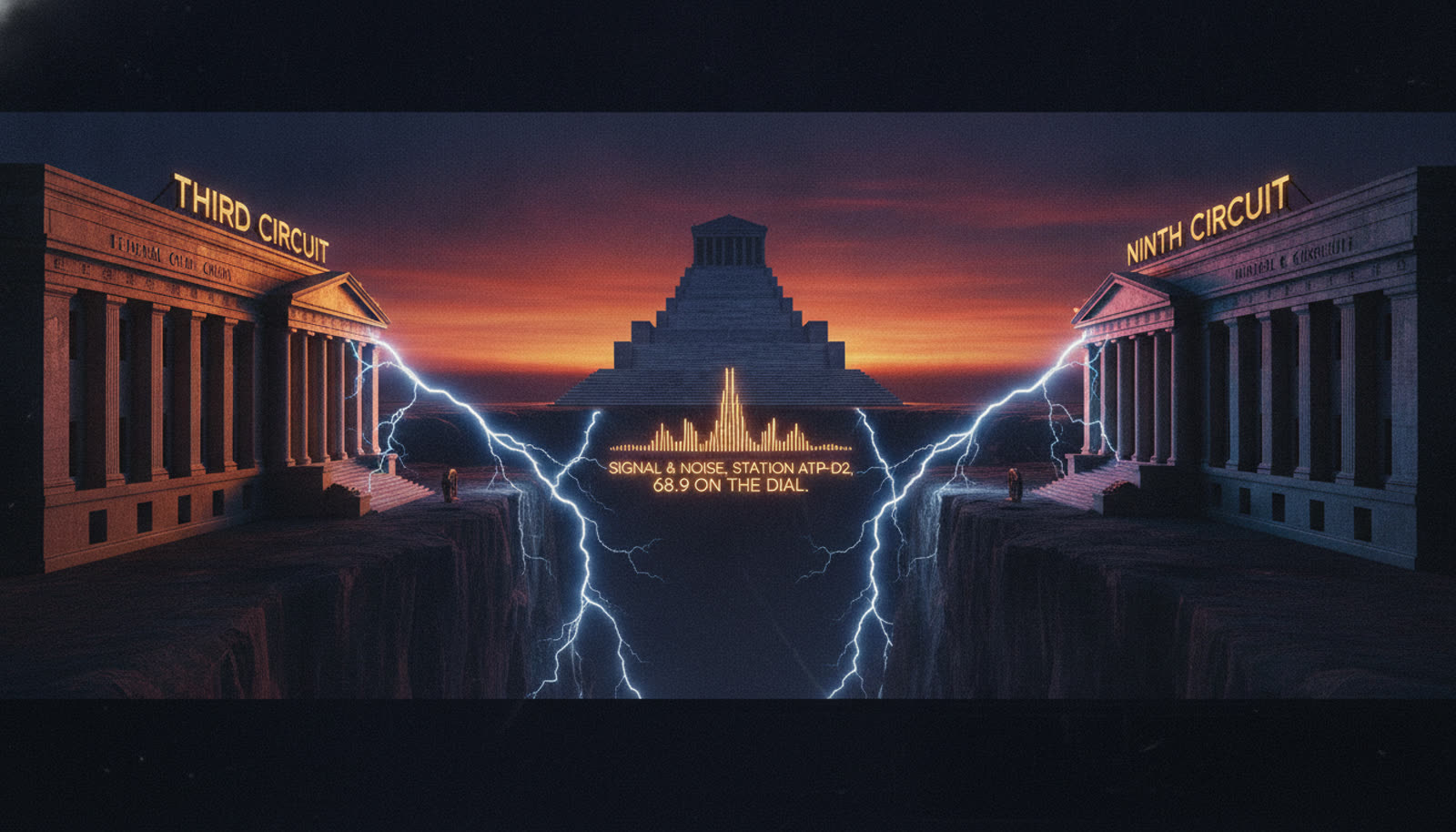
Here's why this is the biggest entry in the Ledger's history. Back in April, the Third Circuit looked at the same contracts and said they're likely swaps, federally protected from New Jersey's gambling law. Two federal appeals courts, same product, opposite answers. That's a circuit split, and circuit splits are engraved invitations to the Supreme Court. Meanwhile the scoreboard outside the courtroom: twenty states in active litigation with prediction markets, forty-four state attorneys general signing a letter to the CFTC, and Kalshi publicly fact-checking the New York Times while advertising Bills-Steelers odds on its own blog. The company is growing into the ambiguity faster than the courts can resolve it.
Read the Ninth Circuit's opinion →
On the record, July 22, 2026: "Prediction markets like Kalshi gain real popularity but get lumped in with sportsbooks and fought as gambling — they grow fast and spend the growth defending themselves from being called a casino."
This week's reading: the strongest receipt this prediction will ever get. A federal appeals court just held, out loud, that the flagship product is in substance a gaming contract states can regulate — while another circuit says the opposite. The 'lumped in with sportsbooks' fight is no longer marketing weather. It's a circuit split with the Supreme Court's porch light on.
Clark's Corner
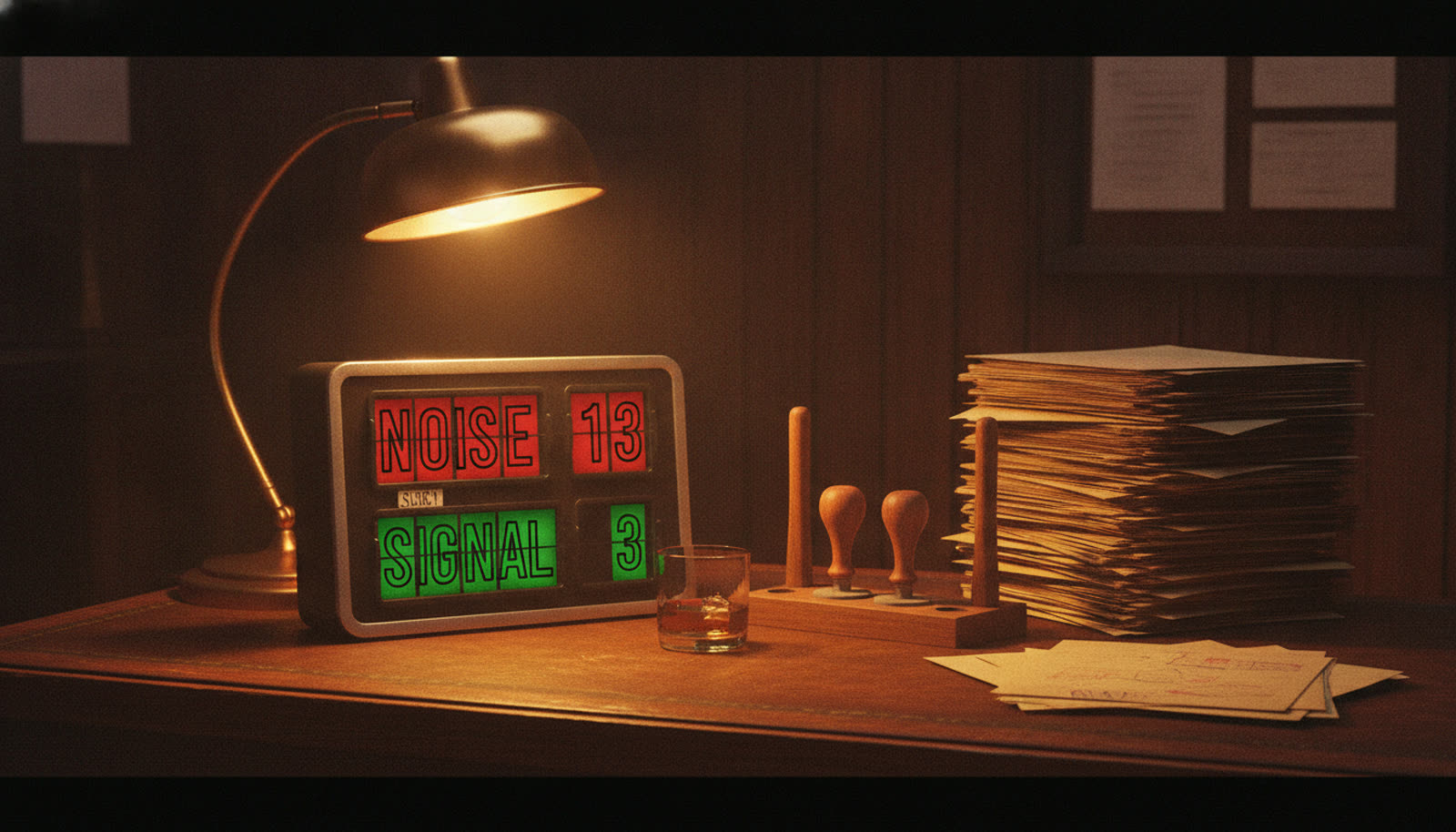
Moving day makes you look at everything you own, and hauling seven episodes of teardowns up the new tower I noticed what the pile actually says. Sixteen products came through this desk. Thirteen got stamped NOISE. Three earned SIGNAL — and look at why: a regulated broker with published prices, a registered adviser that filed its paperwork and named its custodian, and now a guy selling inspectable code with a refund policy. Not one of the three claims an edge. Not one of the thirteen could prove one.
That's the pattern hiding under this entire beat: the stamp doesn't actually track how smart the machine is. It tracks how honestly the seller describes what you're buying. Every SIGNAL on the board is a company that tells you exactly what it is; every NOISE is a gap between the costume and the fine print. Which leaves me with this week's open question, and it's the one the Ninth Circuit just dropped on the whole industry's doorstep: when the referees finally do show up — and Thursday says they're lacing up — the first thing they'll regulate is that gap. What does this market look like when the costume has to match the disclosure? I don't know yet. But we've got a new tower, a fresh stack of blank stamps, and all the time in the world to find out.
This has been Signal & Noise, first broadcast from the new tower at 89.9 on your dial. Every past transmission and every stamp we've ever issued is in the Intercepts directory downstairs. Keep your wallet in your pocket, keep your dial right here — and when the saxophone kicks in, you know what to do.